
Relationships and Everyday Life: Top 5 Stories for Gen Z
Ranking at a glance
Three of the five stories have candidate clips; the two without get 30 to 60 second editorial scripts built on our own graphics.
| Rank | Story | Score | Clip status | Video format |
|---|---|---|---|---|
|
1 |
Gen Z is dating more but still doesn’t want AI writing its texts |
88 |
Candidate clip (Bloomberg, prior-year survey); licence needed |
Clip plus voiceover, about 45 sec |
|
2 |
1 in 7 partnered young adults has a secret AI romantic companion |
84 |
Candidate local-TV segments (KSL, ABC4); permission needed |
Clip plus voiceover, about 45 sec |
|
3 |
A third of under-35s live with their parents, and 70% have jobs |
80 |
Local TV coverage exists; video not confirmed |
Clip plus voiceover, about 45 sec |
|
4 |
Lonely despite having friends: the “social ambivalence” finding |
70 |
No clip found |
Editorial script, about 50 sec |
|
5 |
Millennials vs. Gen Z dating habits: what the data says |
62
|
No clip found |
Editorial script, about 50 sec |
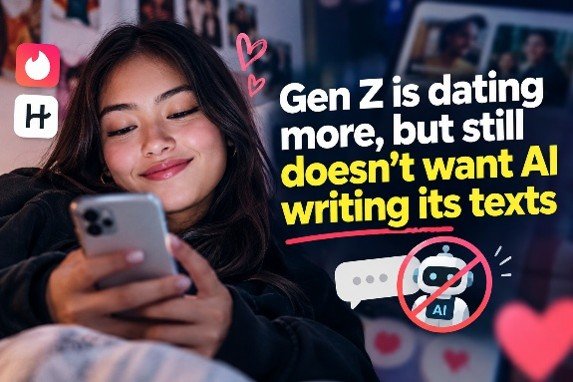
Story 1: Gen Z is dating more, but still doesn't want AI writing its texts
Audience: US dating-app users ages 18 to 28. Category: Relationships and Everyday Life. Score: 88/100
Article (about 190 words): More young people are dating again, but they are wary of AI doing the talking. A Bloomberg Intelligence survey released October 28 found that 34% of dating-app users ages 16 to 28 are single and currently dating, up from 23% a year earlier. The survey polled 1,000 US dating-app users between August 26 and September 21.
The comfort gap on AI is the headline. Barely more than half of Gen Z users said they are at ease with AI writing their replies and keeping chats going, compared with 70% of millennials. The same survey found users are more willing to pay for subscriptions as they age, though they remain more price-sensitive than millennials.
Other surveys point the same way. A Hily survey of 3,500 daters found 64% of Gen Z would not date someone who routinely uses AI, versus 56% of millennials. Yet a Kinsey Institute study reportedly found 67% of Gen Z singles have used AI while dating, compared with 46% of millennials.
Those findings only look contradictory if you assume people want the same thing from AI when they use it as when a date does. Surveys also measure stated preferences, not actual behavior. For apps such as Tinder and Hinge, which are adding AI features, that gap is the business risk.
Risks
- The Kinsey 67% figure comes only from a secondary roundup that labels it “2026 Singles in America.” Match and Kinsey’s 14th annual study was released June 2025, so confirm the year and number with Match or Kinsey before using it.
- Surveys are of dating-app users, not all young people. The Bloomberg poll is a commissioned analyst survey.
- Match Group and Hily are commercial parties; say so when citing their data.
Video package
- Clip candidate: Bloomberg video on the 2025 version of this survey. It covers last year’s findings, not today’s numbers, so use it only as b-roll context if licensed.
- Rights: Bloomberg footage needs a licence or an official embed. Do not download and re-upload it.
- Voiceover (about 45 sec): “Gen Z is dating more. A new Bloomberg Intelligence survey says 34% of young app users are single and dating, up from 23% last year. But when it comes to letting AI write your texts, only about half of Gen Z is comfortable with it, versus 70% of millennials. And 64% of Gen Z say they wouldn’t date someone who routinely uses AI. The catch: lots of young daters use AI themselves. So the real question isn’t whether you use it. It’s whether your date can tell.”
- On-screen text: 34% dating (vs 23%) · ~50% comfortable with AI replies · 70% of millennials.
- Fallback if no licence: animated stat cards in our own style, no third-party footage.
Story 2: 1 in 7 partnered young adults has a secret AI romantic companion

Audience: Young adults in relationships, ages 18 to 30, and their partners. Category: Relationships and Everyday Life. Score: 84/100.
Article (about 185 words)
A study from Brigham Young University’s Wheatley Institute and the Institute for Family Studies says about 15% of young adults in committed relationships regularly interact with an AI chatbot that plays the role of a romantic partner. The survey, published May 19, polled 2,431 US adults ages 18 to 30 who were dating, engaged or married.
Secrecy was common. According to the institute, more than half of partnered users either hide their use completely or tell their real-life partner only part of the story. Roughly half of users wished their partner would act more like their chatbot.
Use was associated with lower relationship stability and weaker communication. The researchers say they cannot tell which comes first: AI use may weaken the relationship, or people in struggling relationships may be more likely to turn to AI. The survey is self-reported and captures one partner’s view.
Lawmakers are moving. California’s companion-chatbot law took effect January 1, 2026, and requires operators to disclose that users are talking to AI and to have protocols for self-harm conversations. New York has a similar law.
The takeaway for couples is simple: this is now a conversation about boundaries, much like how partners handle social media and dating apps.
Risks
- The study is from a family-focused institute and is cross-sectional. Do not say AI causes breakups.
- It is five months old. Pair it with the new regulation angle or fresh reader responses.
- Disclosure: this report was drafted with an Anthropic model, and Anthropic makes AI assistants. Disclose that if the piece discusses AI companies or chatbot regulation, and verify the law details against the statutes.
Video package
- Clip candidates: local-TV segments on the study from KSL and ABC4. I did not confirm either page carries embeddable video.
- Rights: Request permission or use the station’s embed. Researcher interview clips belong to the station.
- Voiceover (about 45 sec): “A BYU study asked more than 2,400 young adults in relationships about AI. About one in seven said they regularly talk to an AI chatbot that acts like a romantic partner. More than half of those users hide it from their real partner, at least partly. The researchers can’t say if the chatbot hurts the relationship or if people already struggling turn to it. Either way, California and New York now require these apps to disclose they’re AI. Worth a conversation with your partner.”
- On-screen text: 15% · 2,431 adults, ages 18 to 30 · More than half hide it.
- Fallback if no licence: animated chat-bubble graphics we build ourselves.
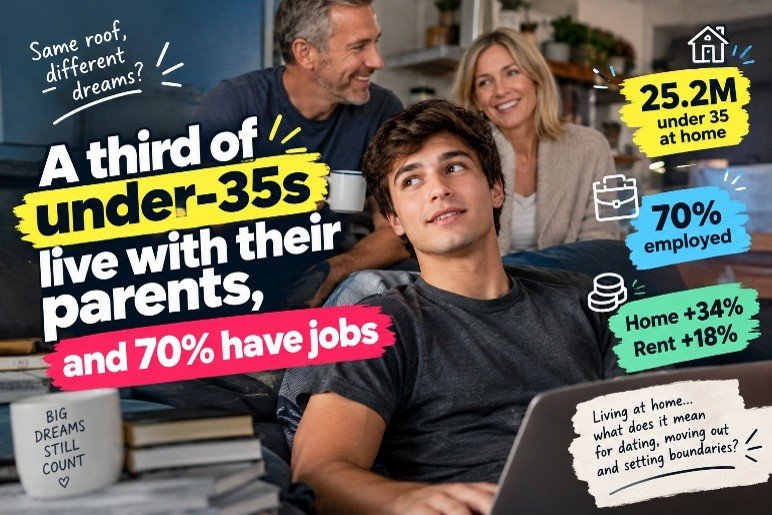
Story 3: A third of under-35s live with their parents, and 70% have jobs
Audience: Gen Z and young millennials ages 22 to 34, plus their partners and parents. Category: Relationships and Everyday Life. Score: 80/100.
Article (about 185 words)
A record 25.2 million US adults under 35 lived with their parents in 2025, nearly one in three, according to a Realtor.com report. About 70% of 25- to 34-year-olds in that situation are employed, which challenges the idea that they are waiting on a job. Realtor.com economist Hannah Jones said the growth is coming from working adults.
The cost backdrop explains why. The median home price was $430,000 in 2025, up 34.4% from 2019, while median asking rent reached $1,673, up 17.9%.
It is not a free ride for most. Pew data from 2024 shows 72% of young adults living with parents contribute to the household. Of those, 65% help pay for groceries or utilities and 46% help with rent or the mortgage. A 2026 Wells Fargo survey found 64% of parents of Gen Z adults ages 18 to 28 say their children still rely on them for money, housing or other support.
The relationship effects are the story for our audience: how to date, move in with a partner, or set boundaries with parents while sharing a roof, and how parents adjust their own plans. Some are delaying downsizing, according to reporting on the report.
Risks
- This report is four months old. Our new angle is reader testimony on relationships and boundaries, which we do not have yet.
- Age ranges differ across sources: 18 to 34, under 35, and 25 to 34. Keep each figure tied to its own range.
- Pull the primary figures from Realtor.com and Pew before publishing. Do not run the “$13,000 saved per year” figure I saw on a radio-station page without checking the Federal Reserve source.
Video package
- Clip candidates: several Fox-owned local stations ran the story in June 2026 (for example Fox 2 Detroit). I did not confirm that those pages carry video. Check each before requesting.
- Rights: The stations own the footage. Request permission, or shoot our own street interviews with consent releases.
- Voiceover (about 45 sec): “Nearly one in three Americans under 35 lives with their parents. That’s a record 25 million people. And about 70% of those ages 25 to 34 have jobs. The reason is the math: home prices are up 34% since 2019 and rent is up 18%. Most of them pay in, too. Pew says 72% contribute to the household. So what does that do to dating, moving in together, or setting boundaries with mom and dad? Tell us what it’s like.”
- On-screen text:2M under 35 at home · 70% employed · Home +34%, rent +18%.
- Fallback if no licence: reader-submitted voice notes over our own graphics, with consent.
Story 4: Lonely despite having friends: the "social ambivalence" finding

Audience: Young adults ages 18 to 29, especially those who recently moved, changed jobs or ended a relationship. Category: Relationships and Everyday Life. Score: 70/100.
Article (about 185 words)
Many young adults have friends they like and still feel lonely, and researchers say the reason may be instability, not a lack of people. A University of Kansas study of 4,812 Americans, led by professor Jeffrey Hall and published in PLOS ONE, found that emerging adults report the highest levels of both social connection and loneliness. The researchers call the pattern social ambivalence.
Most young adults in the study were satisfied with their friendships and confident they could make new ones. What they lacked was permanence and routine. Hall’s explanation is that young adulthood is a period of constant change, with new cities, jobs and relationships, and that unpredictability makes close ties feel less secure.
The news peg is a new global alert. A World Health Organization report, as summarized by bdnews24 on October 7, says people ages 13 to 29 report the highest loneliness of any age group. In the US, the Surgeon General’s 2023 advisory found young adults were twice as likely to report loneliness as people 65 and older.
The practical takeaway: recurring, low-stakes routines such as a weekly run, a standing dinner or a club may matter more than adding contacts.
Risks
- The Kansas study was published in late 2025. The WHO peg is the only October 2026 hook, and I saw it only through a secondary outlet. Find the WHO report itself before relying on it.
- The “routines may matter more” line is our inference from the researchers’ framing, not a tested intervention. Label it that way.
- Loneliness stories touch mental health. Add a support-resources line and avoid diagnostic language.
Video package
- Clip candidates: none found. See the 50-second editorial script below.
- Visuals: our own animated graphics. No stock footage of real people unless licensed.
Story 5: Millennials vs. Gen Z dating habits: what the data says
Audience: Gen Z and young millennial daters ages 18 to 35. Category: Relationships and Everyday Life. Score: 62/100.
Article (about 185 words)
Two outlets published lists this week of Gen Z dating habits that millennials say they can’t stand. Vice, on October 23, named AI companions, situationships and excessive therapy-speak. BuzzFeed, on October 20, compiled 16 behaviors from millennial readers, including ghosting and the “ick.” These are opinion roundups and crowd submissions, not data.
The data tells a different story in places. Hinge’s Gen Z D.A.T.E. report, published in November 2025 and cited by Stacker, found 42% of heterosexual Gen Z women on Hinge believe the men they date don’t want deep conversations early on. But 65% of heterosexual Gen Z men say they do. That is a perception gap, not a values gap.
Bloomberg Intelligence’s October 28 survey adds that 34% of dating-app users ages 16 to 28 are single and dating, up from 23%, so more people are in the pool, not fewer.
The angle for us is to ask both generations the same questions and let the numbers settle some arguments.
Risks
- The Hinge figures are from the company’s own report, seen only through a secondary summary. Check Hinge’s published report.
- The source lists are opinion and the story can read as generational mockery. Do not run stereotypes about either group.
- I saw one outlet’s claim that 37% of Gen Z identifies as celibate. I did not verify it and left it out.
Video package
- Clip candidates: none found. See the 45-second editorial script below.
- Visuals: our own split-screen “perception vs. reality” graphic. Avoid quoting commenters from BuzzFeed or Vice without permission.
Editorial scripts for stories without clips
Both scripts use our own animated graphics and need no third-party footage. Read at a natural pace of about 140 words per minute.
Story 4 script: “Lonely, but not friendless” (about 50 sec, 118 words)
0:00 to 0:08, on screen: a phone full of contacts, one empty chat. You’ve got friends. You like them. And you still feel lonely. If that’s you, it isn’t a personal failure.
0:08 to 0:25, on screen: “4,812 Americans” and “high connection + high loneliness.” A University of Kansas study of 4,812 Americans found young adults report the highest levels of both connection and loneliness. Researchers call it social ambivalence.
0:25 to 0:40, on screen: icons for new city, new job, breakup. Their explanation isn’t that you lack people. It’s that your life keeps changing, so nothing feels permanent. New city, new job, new relationship.
0:40 to 0:50, on screen: “Same time. Same place. Every week.” So maybe the fix isn’t more friends. It’s one recurring thing that stays put. A standing dinner. A weekly run. What’s yours?
Editor’s note: the “standing routine” line is our inference, not a tested finding. Add a support-resources card at the end.
Story 5 script: “What they think vs. what they said” (about 45 sec, 108 words)
0:00 to 0:08, on screen: split screen, “Millennials say” and “Gen Z says.” Millennials are listing Gen Z dating habits they can’t stand. Situationships, therapy-speak, the ick. But lists aren’t data.
0:08 to 0:25, on screen: “42%” and “65%” with Hinge source tag. Here’s some data. Hinge found 42% of straight Gen Z women think the men they date don’t want deep conversations early. But 65% of straight Gen Z men say they do.
0:25 to 0:38, on screen: “34% single and dating, up from 23%.” And Bloomberg says 34% of young app users are single and dating, up from 23% last year.
0:38 to 0:45, on screen: question card. So maybe the gap is perception, not values. Which one are you? Tell us.
Editor’s note: confirm Hinge’s figures in the original report before publishing. Label them as Hinge’s own survey.
Publishing checklist
- Clear rights for any third-party clip, or switch to the fallback graphics.
- Verify each flagged figure against its primary source.
- Add the Anthropic disclosure to Story 2 and to any story that cites AI companies.
- Add captions and alt text to every video before publishing.
- Track each story’s views, watch time, shares and saves so next week’s report has real data.